The Mount of the Souls Becquer Read Free
| Gustavo Adolfo Bécquer | |
|---|---|
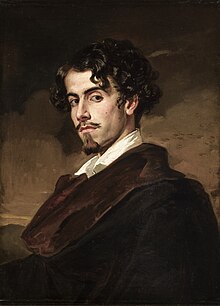 Gustavo Adolfo Bécquer by his brother, Valeriano Bécquer | |
| Born | Gustavo Adolfo Domínguez Bastida (1836-02-17)February 17, 1836 Seville, Spain |
| Died | Dec 22, 1870(1870-12-22) (aged 34) Madrid, Spain |
| Occupation | Poet, writer, announcer |
| Nationality | Spanish |
| Signature |  |
Gustavo Adolfo Claudio Domínguez Bastida (Feb 17, 1836 – Dec 22, 1870), improve known equally Gustavo Adolfo Bécquer (Castilian pronunciation: [ɡusˈtaβo aˈðolfo ˈβekeɾ]), was a Castilian Romanticist poet and author (mostly brusque stories), likewise a playwright, literary columnist, and talented in drawing. Today he is considered one of the most important figures in Castilian literature, and is considered by some equally the most read writer afterwards Miguel de Cervantes.[1] He adopted the alias of Bécquer as his brother Valeriano Bécquer, a painter, had done earlier. He was associated with the romanticism and mail-romanticism movements and wrote while realism was enjoying success in Espana. He was moderately well known during his life, but it was after his expiry that near of his works were published. His best known works are the Rhymes and the Legends, unremarkably published together every bit Rimas y leyendas. These poems and tales are essential to the report of Castilian literature and mutual reading for high-schoolhouse students in Spanish-speaking countries.
His work approached the traditional verse and themes in a modernistic fashion, and he is considered the founder of modern Spanish lyricism. Bécquer'due south influence on 20th-century poets of the Spanish language tin be felt in the works of Luis Cernuda, Octavio Paz, and Giannina Braschi.
Bécquer influenced numerous later Spanish-language writers, including Luis Cernuda, Giannina Braschi, Octavio Paz, Antonio Machado, Juan Ramón Jiménez. Bécquer himself was influenced by – both directly and indirectly — Cervantes, Shakespeare,[two] Goethe,[three] Heinrich Heine[4]
Biography [edit]
Gustavo Adolfo Bécquer was born in 1836 with the final name of Domínguez Bastida, but he chose his Flemish father's 2d last name of Bécquer, as the family unit was known around town. His father, José Domínguez Bécquer, who descended from an originally-Flemish family established in the Andalusian majuscule in the 16th century that was well respected in the city, was a painter of relatively good repute in his native town. His paintings were sought subsequently, particularly amongst tourists visiting the surface area. José had a great talent, and this greatly influenced young Gustavo, who showed a love for painting and an innate power for drawing and sketching at an early age. He was very talented, and connected drawing throughout his life, though it was never his main focus.
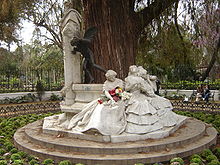
Glorieta de Bécquer in Seville, Spain
Bécquer was left an orphan at an early on age: he lost his father at age 5, and his mother only 6 years later. Young Gustavo began his educational activity at San Antonio Abad school, until he was admitted as a student of San Telmo school in 1846, a nautical institution. It was at that schoolhouse where he met Narciso Campillo, with whom he built a strong friendship. Information technology was too with Campillo that Bécquer began to bear witness his literary vocation, as the 2 boys started writing while sharing time at San Telmo. A yr later, the school was closed past royal order. Gustavo and his siblings were and then taken in past their uncle, Don Juan de Vargas, who cared for the children as if they were his own. Presently after, Gustavo went on to live with his godmother, Doña Manuela Monahay, whose extensive library provided young Bécquer with endless hours of amusement, which Doña Manuela allowed with pleasure. During this period, Campillo remembers that the poet barely left his godmother's house, as he spent hours devouring the volumes of her library. Gustavo's godmother, a well-educated person and also well-to-exercise, supported his passion for report of the arts and history. Nonetheless, she wanted Gustavo to have a profession, and so in 1850 she got him admitted as a educatee into the studio of Don Antonio Cabral Bejarano, at the Santa Isabel de Hungría school. Gustavo worked at the studio for only two years, when he moved to his uncle Joaquin'due south studio and continued developing his skills aslope his brother Valeriano, who was already studying there. Gustavo and Valeriano became from this indicate very close friends, and they both influenced each other profoundly throughout their lives. Luciano, another brother of the poet, besides studied with them during this menses. Studying the art of drawing did non distract Gustavo from his passion for verse; furthermore, his uncle Joaquin paid for his Latin classes, which brought him closer to his beloved Horace, one of his earliest influences. Joaquin besides noticed the keen aptitude of his nephew for words, and encouraged him to pursue writing equally a career, reverse to the designs of Doña Manuela, with whom Gustavo was still living at the time.
In 1853, at the age of seventeen, he moved to Madrid to follow his dream of making a proper noun for himself as a poet. Along with his friends Narciso Campillo and Julio Nombela, both poets also, they had dreamed of moving to Madrid together and selling their poetry for practiced coin, though reality proved to be quite different. Nombela was the first to leave for Madrid that twelvemonth, alongside his family unit. After long arguments over the trip with Doña Manuela, who resisted the idea, Bécquer finally left for Madrid in Oct of that aforementioned year, alone and quite poor, except for the little money that his uncle provided for him. The third friend, Campillo, did not leave Seville until some time later on.

Life in Madrid was not like shooting fish in a barrel for the poet. The dream of fortune that had guided his steps towards the urban center were replaced past a reality of poverty and disillusionment. The two friends were soon joined past Luis García Luna, besides a poet from Seville, who shared the aforementioned dreams of greatness. The three began writing and trying to make themselves known equally authors, without much luck. Bécquer, the only one of the three without a existent chore and a steady income, went to alive with an acquaintance of Luna, Doña Soledad. A twelvemonth later, in 1854, he moved to Toledo with his blood brother Valeriano, a lovely place in which he was able to write his book: "History of the Spanish temples". The poet was interested in Lord Byron and his "Hebrew Melodies" or his "Heine del Intermezzo", with Eulogio Florentino'due south aid in the translation.
The poet died on December 22, 1870 from tuberculosis, an disease known equally "the romantic disease" because of how common information technology was during the romantic period in Spain. Earlier this tragic sickness took his life away, Bécquer asked his skillful friend, Augusto Ferrán, also a poet, to burn all his letters and publish his poems instead, since he thought once he was expressionless, his work would be more valuable. His body was cached in Madrid, and subsequently was moved to Seville along with his brother's.
Early career [edit]
Later on several failed commercial attempts with his friends, the writer finally accepted a job as a author for a minor newspaper. This, yet, did non concluding long, and before long Gustavo was out of a job again. Information technology was then that, in 1855, Valeriano arrived in Madrid, and Gustavo went to live with his brother. They would never be apart later on that.
Afterwards a few other unsuccessful attempts at publishing their work, Bécquer and Luna began working together writing comic plays for theater, as a means of making a living. This collaboration continued until 1860. At that time, Bécquer worked intensively on his belated project Historia de los templos de España (History of Spain'southward temples), the first volume of which saw the light of solar day in 1857. It was also during this catamenia that he would meet the young Cuban poet Rodríguez Correa, who would later play a major role in collecting his works for posthumous publication. It was around this time, between 1857 and 1858, that Bécquer became ill, and was left to the care of his brother and friends. Shortly after, he met by chance a daughter by the name of Julia Espín, with whom he fell deeply in love, and who also served as an inspiration for much of his romantic poetry. This dear, however, was unrequited.
Around 1860, Rodríguez Correa constitute Bécquer a government position, from where he was fired shortly after for spending his time writing and drawing while on the job.
Love life and literary career [edit]
In 1861, Bécquer met Casta Esteban Navarro, and married her in May 1861. Bécquer was believed to have had a romance with another girl named Elisa Guillén shortly before the spousal relationship, which is also idea to have been arranged, (if not somewhat forced), by the parents of the girl. The poet was not happy in the marriage, and took any chance he got to follow his brother Valeriano on his constant trips. Casta began to have upward with a homo with whom she had had a relationship shortly before marrying Bécquer, something that was later blamed on Bécquer's trips and lack of attention past Casta'south acquaintances. The poet wrote very little about Casta, as most of his inspiration at this fourth dimension, (as it is the case with the famous rima LIII), came from his feelings towards Elisa Guillén. Casta and Gustavo had iii children: Gregorio Gustavo Adolfo, Jorge, and Emilio Eusebio. The third kid was perchance fruit of the extramarital relations of Casta.
In 1865, Bécquer stopped writing for the prolific literary section of the paper El Contemporáneo, where he had finally gained fame every bit a author, and began writing for two others, El Museo Universal and Los Tiempos, the latter founded later on El Contemporáneo was dissolved. He had besides been appointed to a government post, financial de novelas (supervisor chaser for novels and published literature) past his friend, patron and benefactor, founder of both newspapers El Contemporáneo and Los Tiempos, former President of Spain, and the then Spanish Minister of Abode Affairs, Luis González Bravo. This was a well-paid chore, which Bécquer held on and off until 1868. From this authorities job he was able to get his brother Valeriano a government pension equally an art painter of "Spanish regional folk costumes and traditions". During this flow, the poet full-bodied on finishing his compilations of poems Rimas (Rhymes) and Libro de los gorriones (Book of the Sparrows), and then he did not publish a great deal of his works. A completed manuscript of his poems was given for its publication to Luis González Bravo, (President of Kingdom of spain for a second time in 1868), as he had supportively offered and then to Bécquer, but regrettably information technology was lost during the political revolution of 1868, which hastily exiled President Luis González Bravo and Queen Isabella II of Kingdom of spain to France. Information technology was at this fourth dimension that the poet left Espana for Paris, although he returned non long after. By 1869, the poet and his brother went back to Madrid together, along with Gustavo's sons. Here, he started re-writing the book that had gone missing, due to his loyal benefactor Luis González Bravo's forced exile to French republic the year earlier. Gustavo was, by and so, living a bohemian life, as his friends later described. With the sole purpose of putting bread on the tabular array, Bécquer went back to writing for El museo universal, and and then left to take the task of literary director of a new artistic magazine called La ilustración de Madrid. Valeriano besides collaborated with this project. Gustavo'south publications in this mag consisted mostly of short texts to accompany his brother's illustrations. Around this fourth dimension, between 1868 and 1869, the two brothers published a book of satiric and erotic illustrations under a pseudonym, which humorously critiqued the life of royalty in Spain, called Los Borbones en pelotas.

Title page of Becquer'due south 'Obras' (1871), First Edition
In 1870, Valeriano fell sick and died on September 23. This had a terrible bear upon on Gustavo, who suffered a serious low equally a upshot. Subsequently publishing a few short works in the magazine, the poet also became gravely ill and died in poverty in Madrid, on December 22, almost three months afterward his honey brother. The crusade of death is debated: while his friends described symptoms of pulmonary tuberculosis, a later study indicates that he may have died of liver complications. Some of his final words are said to be "Acordaos de mis niños" ("call up-don't forget- my children".)
After his decease, his friend Rodríguez Correa, with the collaboration of Campillo, Nombela, and Augusto Ferrán, nerveless and organized his manuscripts for publication, every bit a way to help the widow and children of the poet. The first edition of their attempt was published in 1871, and a second book was published six years later on. Further revisions came out on the editions released in 1881, 1885, and 1898.
In such prose tales every bit El Rayo de Luna, El Beso, and La Rosa de Pasión, Bécquer is manifestly influenced by E.T.A. Hoffmann, and as a poet he has analogies with Heine. His work is unfinished and diff, but information technology is singularly free from the rhetoric characteristic of his native Andalusia, and its lyrical avidity is of a beautiful sweetness and sincerity. He too wrote in an epistolary manner: Cartas desde mi Celda – written during his travels to Veruela's Monastery – or La Mujer de Piedra or lilliputian theatre plays La novia y el pantalón. It is non and so well known that he was an fantabulous graphic artist. Well-nigh of his work concentrated on spontaneity of dear and the solitude of nature. His piece of work, and in particular his Rimas, are considered some of the nearly important work in Spanish poesy, greatly influencing the following generations of writers, notably authors similar Antonio Machado and Juan Ramón Jiménez, writers belonging to the Generation of '27, such as Federico García Lorca and Jorge Guillén, and many Hispano-American writers like Rubén Darío.
Works [edit]
Rhymes (Rimas) [edit]
Bécquer'southward poems were recited from retentiveness by his contemporaries, and profoundly influenced the generations afterwards. Modeled in brief stanza forms, both musical and erotic, Bécquer's 77 Rimas came to a few thou lines, considered the foundation of modern Spanish poetry. Luis Cernuda wrote: 'In that location is in Bécquer an essential poet quality: that of expressing with a clarity and firmness that only classics have... Bécquer plays in our modern poetry a role equivalent to Garcilaso's in our classic poetry: that of creating a new tradition, which he bestows upon his descendants. His book was composed after his decease from many sources, the primary i being a manuscript by Bécquer himself, The Book of Sparrows.

Autograph of Bécquer's Rima XXVII
Birds are a motif that shows upward oft in Bécquer's canon, such as in "Rima LIII" (Rhyme 53), where swallows appear as a sign of the end to a passionate relationship.
| Volverán las oscuras golondrinas Pero aquellas que el vuelo refrenaban | The dark swallows volition return But the ones that used to slow their flight |
The refrain "¡Esas... no volverán!" appears in the 20th novel Yo-Yo Boing! past Puerto Rican poet Giannina Braschi, who references Bécquer'south swallows to depict the sorrow and angst of a failed romance.
In Rhymes (Rhyme 21) Becquer wrote i of the virtually famous poems in the Spanish linguistic communication. The poem can exist read every bit a response to a lover who asked what was poesy:
| ¿Qué es poesía?, dices mientras clavas | What is poetry? y'all ask, while fixing |
[edit]
The Legends are a variety of romantic tales. As the name implies, most take a legendary tone. Some describe supernatural and semi-religious (Christian) events, like The Mount of the Souls, The Green Eyes, The Rose of the Passion (a blood libel) with references to the Holy Child of la Guardia and The miserere (a religious vocal). Others cover more or less normal events from a romantic view, similar The Moonlight Ray and Three Dates.
The Leyendas (Legends) are:
- El caudillo de las manos rojas, 1858.
- La vuelta del combate, 1858. (Continued: El caudillo de las manos rojas).
- La cruz del diablo, 1860.
- La ajorca de oro, 1861.
- El monte de las ánimas, 1861.
- Los ojos verdes, 1861.
- Maese Pérez, el organista, 1861.
- Creed en Dios, 1862.
- El rayo de luna, 1862.
- El Miserere, 1862.
- Tres fechas, 1862.
- El Cristo de la calavera, 1862.
- El gnomo, 1863.
- La cueva de la mora, 1863.
- La promesa, 1863.
- La corza blanca, 1863.
- El beso, 1863.
- La Rosa de Pasión, 1864.
- La creación, 1861.
- ¡Es raro!, 1861.
- El aderezo de las esmeraldas, 1862.
- La venta de los gatos, 1862.
- Apólogo, 1863.
- Un boceto del natural, 1863.
- Un lance pesado.
- Memorias de united nations pavo, 1865.
- Las hojas secas.
- Historia de una mariposa y una araña.
- La voz del silencio, 1923, Released past Fernando Iglesias Figueroa.
- La fe salva, 1923, Released by Fernando Iglesias Figueroa.
- La mujer de piedra, Unfinished.
- Amores prohibidos.
- El rey Alberto.
Narrative [edit]
He also wrote some narrative pieces in prose, "Narraciones", which are loaded with imagination and implausibility, such every bit "Memorias de un Pavo" (Memoirs of a Turkey) in which, as the title implies, he describes the trip of a turkey from its home farm to the metropolis, and its purchase to exist eaten, when its writings are discovered inside the already cooked body.
References [edit]
- Díaz, José Pedro. "Gustavo Adolfo Bécquer: vida y poesía". 2da ed. Madrid: Gredos, 1964.
- Blanc, Mario A. "Las rimas de Bécquer: su modernidad". 1ra ed. Madrid: Pliegos, 1988.
- Montesinos, Rafael. "Bécquer: Biografía east imagen". Barcelona: RM, 1977.
- Carlos BOUSOÑO, "Las pluralidades paralelísticas en Bécquer", en ALONSO, Dámaso y BOUSOÑO, Carlos, Seis calas en la expresión literaria española, Madrid, Gredos, 1951.
- Giannina Braschi, "La poesía de Bécquer: El tiempo de los objetos o los espacios en la luz", Universidad Estatal de Nueva York-Stony Brook, 1981.
- David K.Heerrzberger, "The contrasting poetic theories of Poe and Bécquer", Romance Notes, 21, (3), 1980.
- William Samuel Hendrix, "From the Spanish of Gustavo Bécquer", Hispania, California, V, 1922.
- Pablo Muñoz Covarrubias, "Garcilaso de la Vega y la Crítica Literaria de Luis Cernuda". El Colegio de México.
References [edit]
- ^ "´Bécquer es el escritor más leído después de Cervantes´". La Provincia. Diario de las Palmas (in Spanish). July 28, 2011. Retrieved February 22, 2018.
- ^ Rubio Jiménez, Jesús (January 26, 2011). La fama póstuma de Gustavo Adolfo y Valeriano Bécquer. Universidad de Zaragoza. p. 12. ISBN9788415031666.
- ^ Magallanes Latas, Fernando. Actualidad de Goethe (PDF) (in Spanish).
- ^ "Life & works of Gustavo Adolfo Bécquer". Classical Spanish Books. 2011. Retrieved February 22, 2018.
This article incorporates text from a publication now in the public domain:Chisholm, Hugh, ed. (1911). "Bécquer, Gustavo Adolfo". Encyclopædia Britannica (11th ed.). Cambridge Academy Press.

External links [edit]
- Complete Works of Bécquer, in Spanish
- An annotated edition of Rhymes , in Castilian
- Works by Gustavo Adolfo Becquer at Project Gutenberg
- Works past or about Gustavo Adolfo Bécquer at Net Annal
- Works by Gustavo Adolfo Bécquer at LibriVox (public domain audiobooks)

- Obra de Bécquer
- Audiobooks. Read, heed along and download the Rhymes and Legends in Spanish. (Some in English language) Free
Source: https://en.wikipedia.org/wiki/Gustavo_Adolfo_B%C3%A9cquer

Post a Comment for "The Mount of the Souls Becquer Read Free"