How to Cite a Photgraph of Art in Chicago Style
This guide provides examples of citations of commonly-used sources, based on The Chicago Manual of Manner (17th ed.), using notes/bibliography style simply.
Need more? Come across Chicago Style Citation Quick Guide for an overview, or find print versions of the Chicago Manual of Style at the SFU Library and SFU Bookstore.
For the best press results, use the printer-friendly PDF format of this guide.
Figures
In Chicago Way, the term figure tin can refer to illustrations or images that are displayed or reproduced separately from the text. Illustrations or images, in this case, can refer to a wide range of visual materials, including photographs, maps, drawings, and charts placed within a text. [3.1] [3.5]
Figures can be used to more easily refer to illustrations cited in your writing. This is peculiarly helpful where there are several cited illustrations. An example of a textual reference to a figure might look similar the post-obit: "every bit figure ii shows..."; "when comparing figures 3 and 4." The lowercaseeffigy should exist used when making references to figures in the text. [3.9]
Figure captions
Captions are usually included immediately beneath a figure, and provide a text caption of the visual. [three.ix] The amount of detail in captions can vary from a few words to several sentences. Explanation text should, where advisable, exist formatted every bit consummate sentences with capitalization and punctuation. [three.21]
The titles of works, such as those from which the figures are taken, should be reproduced according to the standard Chicago Style rules, discussed in Chapter 8 of the manual, for notes and textual references. [iii.22]
A credit line, which includes a argument most the figure'south source, should be included. [3.29] This credit line ofttimes appears at the stop of a explanation. [3.xxx]
Examples
Figure iv. Frontispiece of Christian Prayers and Meditations (London: John Daye, 1569), showing Queen Elizabeth at prayer in her private chapel. Reproduced by permission of the Archbishop of Canterbury and the Trustees of the Lambeth Palace Library.
Figure 3. Detailed stratigraphy and geochronology of the Dubawnt Supergroup.
Citing figures found in other works
When citing a figure, such as an illustration included inside another text, you can include the abbreviationfig. to refer to the figure.
Format
1. First Name Final Proper noun of creator, Title of Work (Place of publication: Publisher, Year of publication), page number, figure number.
Example
one. Kate van Orden, Music, Authorship, and the Book in the Get-go Century of Print (Berkeley: University of California Press, 2013), 38, fig. 2.
Images
Images are sometimes referred to as illustrations, artwork, or art in the Chicago Style, and refer to images presented separately from text (every bit opposed to an embedded chart or figure). Images, or illustrations, can come in a range of forms, including charts, maps, line drawings, paintings, and photographs. [three.one]
Notation
- Information about paintings, photographs, sculptures, or other works of art tin can usually be presented in the text rather than in a note or bibliography. [xiv.235]
- If note or bibliography entry is needed, follow the guidelines below.
Format
1. Starting time Proper name Last Name of creator, Title of Work, date of creation or completion, medium, Name of Institution, location (if applicable), URL.
Example
Equally illustrated in Three Planets Trip the light fantastic over La Sill [one] ,the phenomenon of 'syzygy' is when celestial bodies align in the sky.
1. Yuri Beletsky, 3 Planets Dance over La Silla, June 3, 2013, photograph, European Southern Observatory, https://world wide web.eso.org/public/images/potw1322a/.
Incorporating images into the text of your paper
- If yous chose to incorporate images into the text of your newspaper, the image should appear as soon as possible later the first text reference to it. [three.eight]
- Images should behave numbers, and all text references to them should be by the numbers (eg. "as effigy 1 shows…") The discussion "figure" should be lowercased and fully spelled out, unless in parenthetical references (where "fig" may exist used). [three.9]
- Beneath the prototype, the caption will brainstorm with "Figure" or "Fig." followed past a number and period. (Eg. Figure 1.) [iii.23]
- A caption may consist of a give-and-take or two, an incomplete or a complete sentence, several sentences, or a combination. [3.21]
- Within a caption, nigh titles (including those for paintings, drawings, photographs, statues, and books) volition be capitalized and italicized. [iii.22]
- A brief statement of the source of an illustration, known equally a credit line, is ordinarily advisable and sometimes required by the owner of the illustration.[3.29]
- A credit line usually appears at the cease of a caption, sometimes in parentheses. [iii.30]
- In addition to author, championship, publication details, and (occasionally) copyright engagement, the credit line should include any folio or figure number. If the work being credited is listed in the bibliography or reference list, merely a shortened grade need announced in the credit line [three.32]
- Illustrations from works in the public domain may be reproduced without permission. For readers' information, all the same, a credit line is advisable. [3.35]
Chicago in-text citation example
When celestial bodies are in alignment (meet fig. 1) information technology is called syzygy.
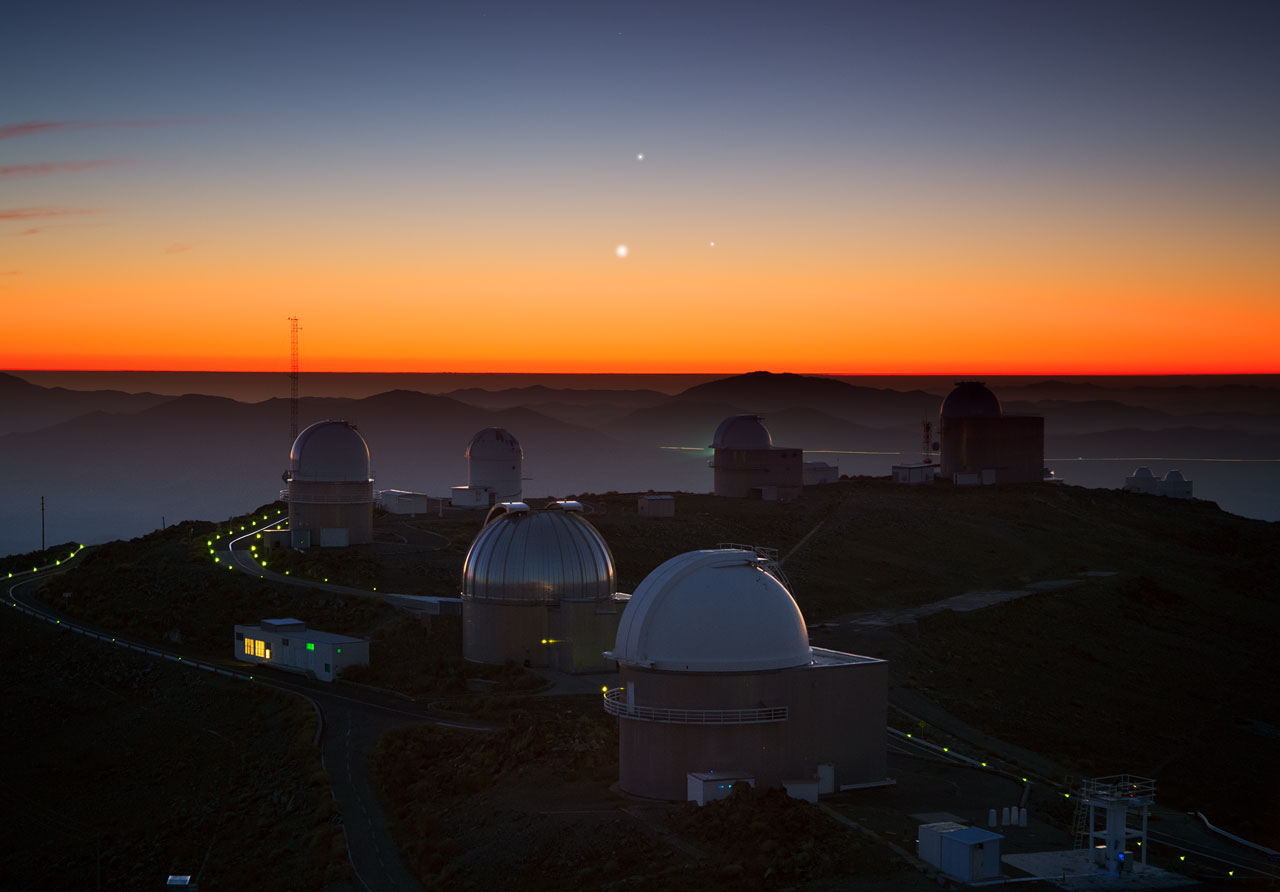
Effigy 1. An example of syzygy (celestial alignment) in a higher place the La Silla observatory, Chile. (Photograph by Yuri Beletsky, Three Planets Trip the light fantastic over La Silla, June 3, 2013, European Southern Observatory, https://www.eso.org/public/images/potw1322a/).
*Note: The above formatting is meant as a guideline simply. There is no definitive format for a figure caption. For case, run into some examples of captions from the Chicago manual:
- Figure 1. Frontispiece ofChristian Prayers and Meditations (London: John Daye, 1569), showing Queen Elizabeth at prayer in her private chapel. Reproduced by permission of the Archbishop of Canterbury and the Trustees of the Lambeth Palace Library.
- Effigy two. Francis Bedford, Stratford on Avon Church from the Avon, 1860s. Albumen print of collodion negative, 18.8 × 28.0 cm. Rochester, International Museum of Photography at George Eastman Business firm.
- Effigy 3. The myth that all children love dinosaurs is contradicted by this nineteenth-century scene of a visit to the monsters at Crystal Palace. (Drawing by John Leech. "Punch'southward Almanack for 1855," Punch28 [1855]: 8. Photo courtesy of the Newberry Library, Chicago.)
Bibliography
General format
Concluding name First proper name. Title of Work. Engagement of creation or completion. Medium. Name of Institution. Location (if applicative). URL.
Example
Beletsky, Yuri. Iii Planets Dance over La Silla. June three, 2013. Photograph. European Southern Observatory. https://www.eso.org/public/images/potw1322a/.
Tables
In Chicago Style, a table is defined every bit list presented as an array with horizontal rows and vertical columns. [3.ii]
When more than i tabular array is included, table numbering is recommended. However, this numbering should be separate from figure/illustration numbering (for example, fig. 1, fig 2., table 1, fig iii.). [3.50]
References to tables in the text should use the lowercase grade of the give-and-take table. [three.50] A numbered table should be included as soon as possible after it is showtime referenced in the text. [iii.51]
Notes to a table come in several types, and are e'er included direct below a table. These notes should have a separate numbering scheme from the text notes. [3.76]
For tables taken from some other source, acknowledgement needs to be made in an unnumbered footnotes starting withSource:orSources: [3.77]
Examples
Sources: Data from Richard H. Adams Jr., "Remittances, Investment, and Rural Asset Aggregating in Pakistan," Economical Development and Cultural Change 47, no. 1 (1998): 155–73; David Bevan, Paul Collier, and Jan Gunning, Peasants and Government: An Economic Analysis (Oxford: Clarendon Press, 1989), 125–28.
Sources: Data from Adams (1998); Bevan, Collier, and Gunning (1989).
Source: https://www.lib.sfu.ca/help/cite-write/citation-style-guides/chicago/chicago-citing-images

Post a Comment for "How to Cite a Photgraph of Art in Chicago Style"